
Discover everything you need to know about stop orders, including what they are, how to place one, and their benefits and risks.
Stop orders are slightly more complex than the more traditional market and limit order types most traders use to open and close positions, but they can be useful in specific situations.
Stop orders include stop-loss and stop-entry. Stop-loss orders tend to be more popular than stop-entry as traders will use them to close open positions if the price action goes against the position by a certain price increment or percentage change. Learn the different stop orders and how to use them in your trading strategy.
A stop order is an instruction to your broker to enter or exit a trade if the market price hits a certain predetermined level, which is less favorable than the current price.
You’ll determine the level at which stop losses will be triggered, within certain parameters—it also depends on whether you’re going long, short and entering or exiting a trade. It is important to note that stop orders do not guarantee order execution at the predetermined price. They trigger a market order when that predetermined price is hit, which can be vulnerable to slippage.
There are two main stop orders: stop-loss and stop-entry.
1. STOP-LOSS ORDER
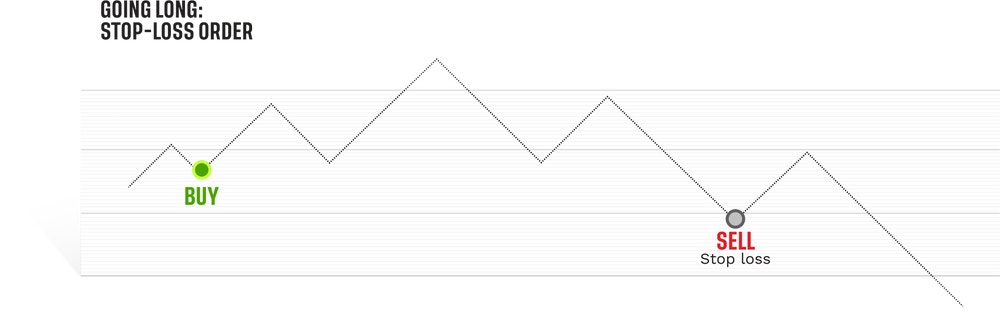
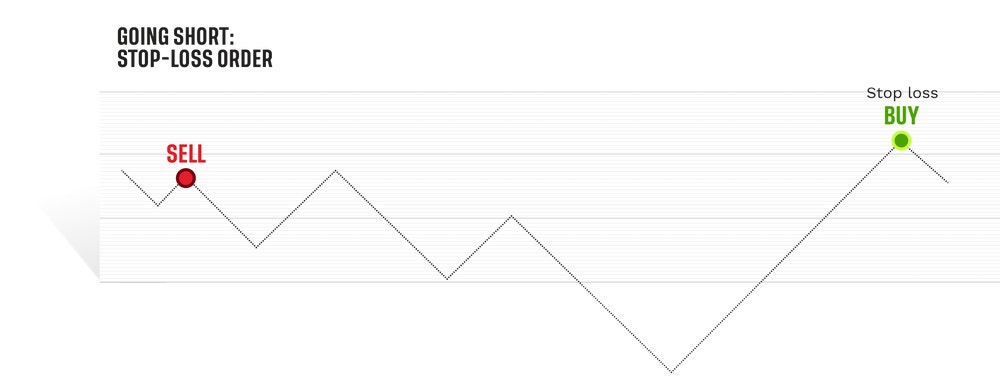
This is when you exit a trade when a price moves against you and hits a certain level of loss—limiting future losses for you. Stop-loss orders can also potentially result in profit if set above the opening level (in the case of a long position, or below it in the case of going short). When the predetermined price limit is reached, your stop-loss order triggers and the position is closed using a market order at the current market prices.
Stop-loss orders are often used as risk management tools set at a certain price lower than your opening position, and it’ll be determined by whatever the amount of loss is that you feel comfortable with in the individual trade. This way, you limit the opportunity that you will lose more than you’re prepared to, if a trade doesn’t work out as expected.
2. STOP-ENTRY ORDER
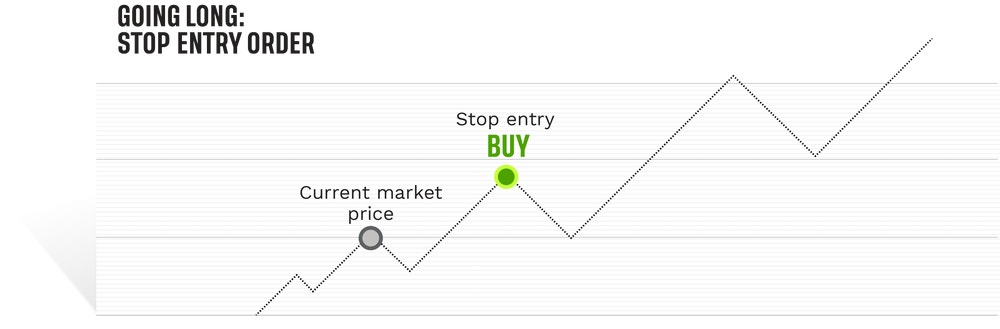
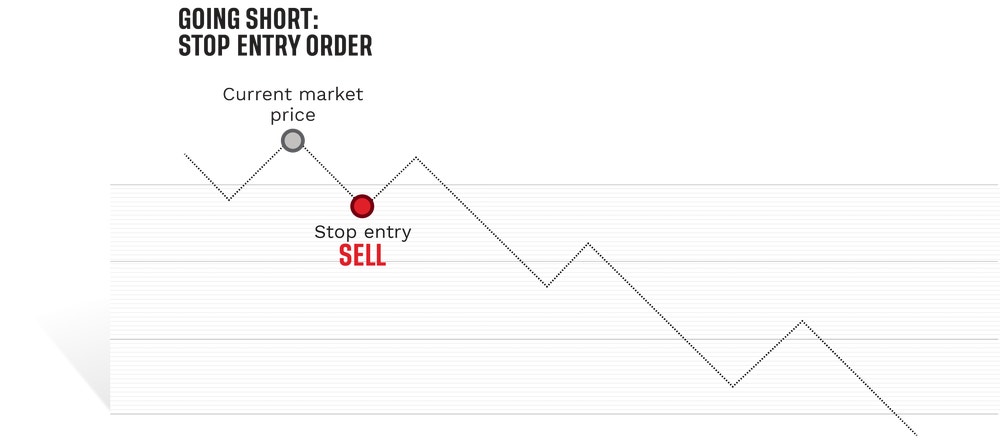
The opposite of a stop-loss order, stop-entry order is used to open a position when the market hits a predetermined level.
Opening a stop-entry order position once the market is moving against you can actually be a valuable strategy for hedging or potentially trading a sudden market spike or downturn. For example, let’s say you believe that, should EUR/USD drop to a certain level, it will rebound significantly and rapidly. So, you set a stop-entry order to capitalize on this, opening a long position should your prediction come true.
Stop orders are designed to work automatically, so you don’t have to watch the market constantly to check whether prices will move against you. This could be especially useful in volatile markets when prices change suddenly and you don’t have time to manually close out a trade that’s turned against you (in the case of stop-loss orders) or open one during a short window of opportunity (in the case of stop-entry orders).
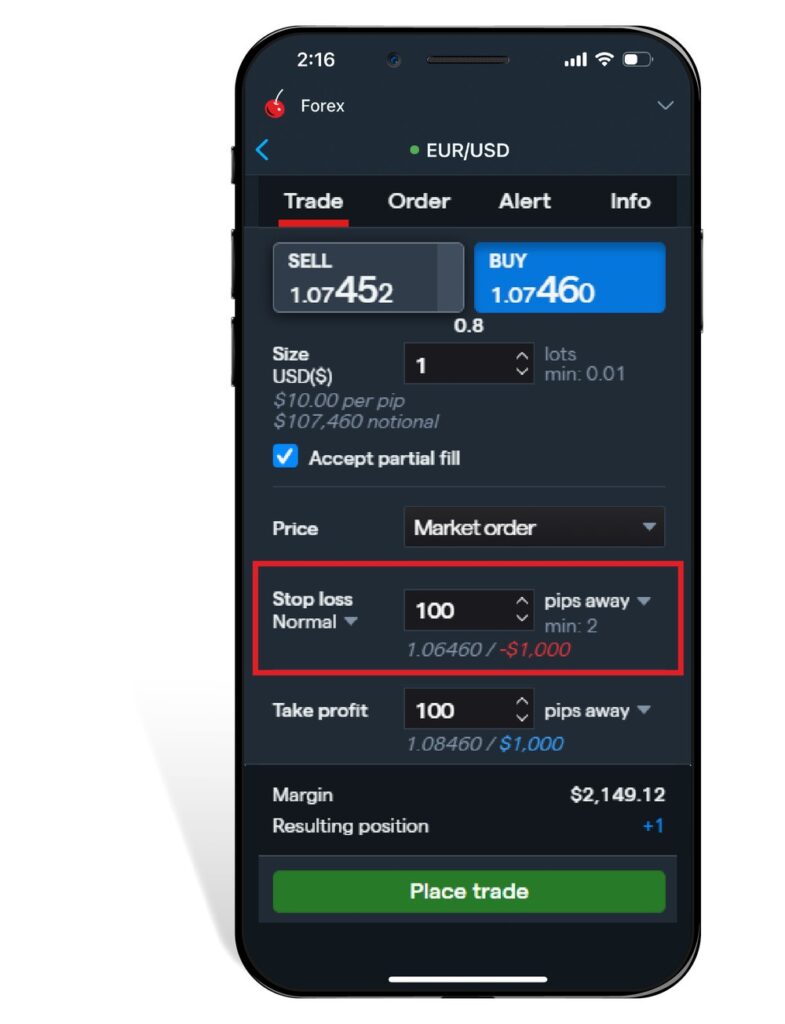
When you open your position, you’ll manually set your stop-loss order parameters. If the market moves against you once your position is opened, your stop order is automatically triggered when the price is reached that you’ve set as your stop amount. At this point, the trade is closed with a market order at current prices to limit further loss. Again, remember that this order is at risk of slippage.
There are two types of stop-loss order. Here are the ones you can use with us:
A stop-entry order involves you manually setting the level at which you want to open a position, if the market moves in your favor.
As in our previous stop-entry example, this may be because you believe that, should the price of EUR/USD hit a certain ‘low’, the price will rally. So, you’d set a stop entry order around the level that you’ve predicted.
If that price level is reached, your stop-entry order automatically opens a long position for you without you having to do anything, enabling you to have the potential to ride the EUR/USD price rally (if your prediction happens to be correct) thanks to your stop-entry order. Losses will accrue the same as any position if prices do not move in the favorable direction.
You’d enter your amount of forex lots to buy or sell and your stop amount. The order will be filled when your stop level has been met, using a market order at the best available price. This market order will attempt to execute at your predetermined price, but the risk of slippage exists especially in volatile periods. Your stop order could execute at less favorable prices.
How you place your stop order will depend on what type of stop order you’re after.
Your position will be opened at the level you set your ‘price level’ at, and closed if the price reaches the level you set your stop at. You can also set limit orders to close your position at a higher level than the opening price.
You’ll be able to edit or add stop-loss orders after opening a position too. You can do this directly from ‘Positions’, where it’s possible to add or change the price that your stop-loss will be triggered.
Your position will be opened at the level you set your ‘price level’ at and closed if the price reaches the level you set your stop at. You can also set limit orders to close your position at a higher level than the opening price.
You’ll be able to edit stop-entry orders after sending them if they have not been hit already. You can do this directly from the ‘Orders’ tab.
There are pros and cons to using stop orders. Understanding them is key to determining whether or not you should be using stops:
BENEFITS OF USING STOP ORDERS
Stop orders can help limit your risk of loss without limiting your potential for profit.
Because stop orders are triggered automatically, you don’t have to constantly monitor your open positions (in the case of stop-loss orders) or the market (in the case of stop-entry orders) to check if prices are moving against you. You should not solely depend on stop orders, however, as checking in regularly on positions, orders, and fills can be helpful.
They can also help you limit the risk of emotional influences, as setting your stop-loss essentially automates when you’ll exit an unfavorable trade.
RISKS OF USING STOP ORDERS
Let’s say you want to go long 1 lot on EUR/USD with an attached stop-loss order to close the position if the market falls 100 pips. You’ve conducted your own analysis and believe that EUR/USD will go up by 100 pips, where you want to take profits, but you do not want to lose more than you would potentially profit if your analysis is incorrect.
If you enter the position at 1.0745, then the stop-loss order will trigger a market order to close the position if EUR/USD falls 100 pips to 1.0645. However, if EUR/USD does not trade down to 1.0645 or lower, then the position will continue to fluctuate in your account until you close it.
If EUR/USD rises to 1.0845 before trading down to 1.0645, then you can close the position for your predetermined profit amount—100 pips. You can also set a take-profit amount on the order ticket for 100 pips that will trigger a market order to close the position if the market trades up to 1.0845.
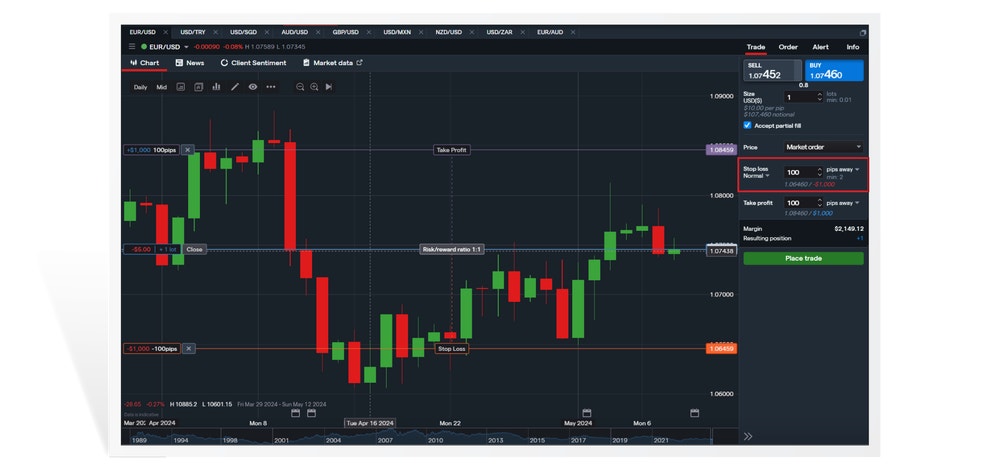
Depending on the movement in the market, the resulting profit or loss will take effect in your account automatically if the stop-loss and take-profit orders are set. If 1.0645 is hit first and the triggered order closes the position for exactly 100 pips in losses on the 1-lot position, then a -$1,000 loss will display in your account. If 1.0845 is hit first and the triggered order closes the position for exactly 100 pips in profits on the 1-lot position, then a +$1,000 profit will display in your account.
(Example excludes potential fluctuations due to overnight funding rates or fees.)
What is forex?
Forex pairs help exchange one currency for another to hedge exposure or speculate on global economies.

Why trade forex?
See if 24-hour access, high liquidity, and low costs make forex products a good fit for your portfolio.
How to trade forex
Market awareness and strategy building are essential to go from theory to practice. Check out examples.

Disclaimer:- Past performance is not necessarily indicative of future results. Leveraged trading in foreign currency or off-exchange products on margin carries significant risk and may not be suitable for all investors. Losses can exceed deposits. We advise you to carefully consider whether trading is appropriate for you based upon your personal circumstances as you may lose more than you invest. The information presented does not take into account your particular investment objectives, financial situation and/or needs and is not a substitute for obtaining professional advice from a qualified person, firm, or corporation, where required. You are advised to perform an independent investigation of any transaction you intend to execute in order to ensure that transaction is suitable for you. Information presented on our website should not be construed nor interpreted as financial advice.
Bestforextrading © All Rights Reserved.