
Forex, also known as foreign exchange or FX trading, is the conversion of one currency into another. Take a closer look at everything you’ll need to know about forex, including what it is, how you trade it and how leverage in forex works.
Forex trading is the means through which one currency is changed into another. When trading forex, you are always trading a currency pair—selling one currency while simultaneously buying another.
Each currency in the pair is listed as a three-letter code, which tends to be formed of two letters that stand for the region, and one standing for the currency itself.
Example: USD stands for the US dollar and JPY for the Japanese yen. In the USD/JPY pair, you are buying the US dollar by selling the Japanese yen.
To keep things ordered, most providers split pairs into categories.
Institutional forex trading takes place directly between two parties in an over-the-counter (OTC) market. Meaning there are no centralized exchanges (like the stock market), and the institutional forex market is instead run by a global network of banks and other organizations.
Transactions are spread across four major forex trading centers in different time zones: London, New York, Sydney, and Tokyo. Since there is no centralized location, you can trade forex 24 hours a day.
Most traders speculating on forex prices do not take delivery of the currency itself. Instead, traders will make exchange rate predictions to take advantage of price movements in the market. The most popular way of doing this is by trading derivatives, such as a rolling spot forex contract offered by Bestforexlearning.
Trading derivatives allows you to speculate on an asset’s price movements without taking ownership of that asset. For instance, when trading forex with tastyfx, you can predict on the direction in which you think a currency pair’s price will move. The extent to which your prediction is correct determines your profit or loss.
The first currency listed in a forex pair is called the base currency, and the second currency is called the quote currency. The price of a forex pair is how much one unit of the base currency is worth in the quote currency.
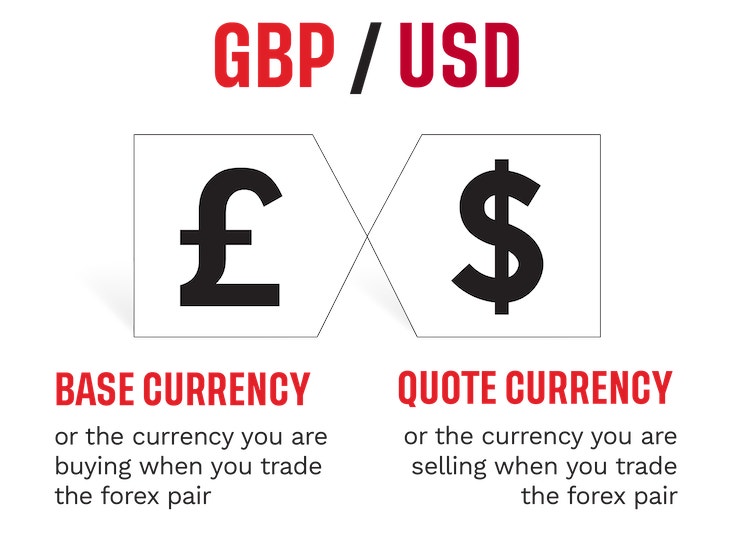
In the above example, GBP is the base currency and USD is the quote currency. If GBP/USD is trading at 1.35361, then one pound is worth 1.35361 dollars.
If the pound rises against the dollar, then a single pound will be worth more dollars and the pair’s price will increase. If it drops, the pair’s price will decrease. So, if you think that the base currency in a pair is likely to strengthen against the quote currency, you can buy the pair (going long). If you think it will weaken, you can sell the pair (going short).
A key advantage of spot forex is the ability to open a position on leverage. Leverage allows you to increase your exposure to a financial market without having to commit as much capital.
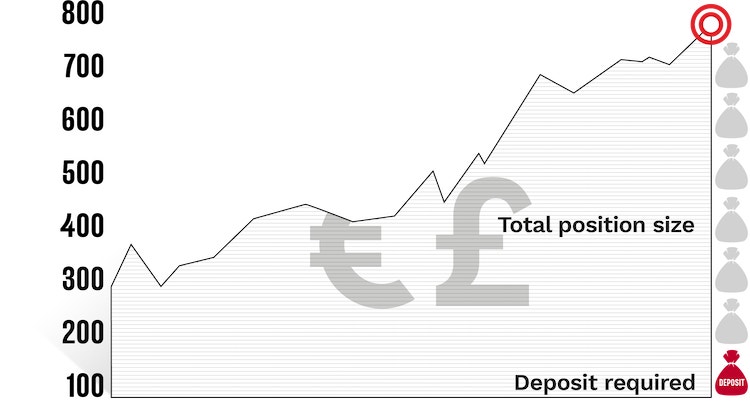
When trading with leverage, you don’t need to pay the full value of your trade upfront. Instead, you put down a small deposit, known as margin. When you close a leveraged position, your profit or loss is based on the full size of the trade.
This means that leverage can magnify your profits, but it also brings the risk of amplified losses—including losses that can exceed your initial deposit. Leveraged trading, therefore, makes it extremely important to learn how to manage your risk.
Margin is a key part of leveraged trading. It is the term used to describe the initial deposit you put up to open and maintain a leveraged position. When you are trading forex with margin, remember that your margin requirement will change depending on your broker, and how large your trade size is.
Margin is usually expressed as a percentage of the full position. So, a trade on EUR/USD, for instance, might only require a deposit of 2% of the total value of the position for it to be opened. Meaning that while you are still risking $10,000, you’d only need to deposit $200 to get the full exposure
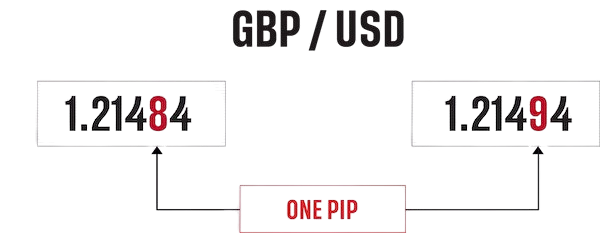
Pips are the units used to measure movement in a forex pair. A forex pip usually refers to a movement in the fourth decimal place of a currency pair. So, if GBP/USD moves from $1.21484 to $1.21494, then it has moved a single pip. The decimal places that are shown after the pip are called micro pips, or sometimes pipettes, and represent a fraction of a pip.
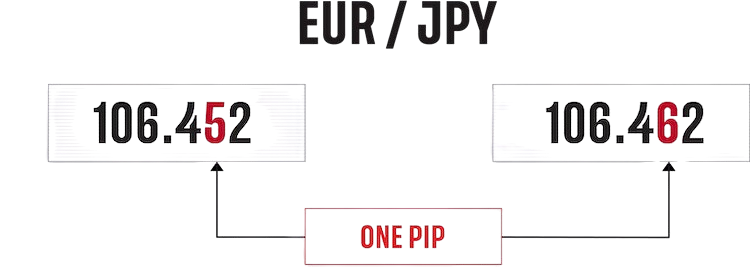
The exception to this rule is when the quote currency is listed in much smaller denominations, with the most notable example being the Japanese yen. Here, a movement in the second decimal place constitutes a single pip. So, if EUR/JPY moves from ¥172.119 to ¥172.129, it has moved a single pip.
In forex trading, the spread is the difference between the buy and sell prices quoted for a forex pair. If, for instance, the buy price on EUR/USD was 1.7645 and the sell price was 1.7649, the spread would be four pips.
If you want to open a long position, you trade at the buy price, which is slightly above the market price. If you want to open a short position, you trade at the sell price—slightly below the market price.
We offers competitive spreads of 0.8 pips for EUR/USD and USD/JPY, and 1 pip on GBP/USD, AUD/USD and EUR/GBP.
Currencies are traded in lots—batches of currency used to standardize forex trades. In forex trading, a standard lot is 100,000 units of currency. Alternatively, you can sometimes trade mini lots and micro lots, worth 10,000 and 1000 units respectively
Individual traders don’t necessarily have 100,000 dollars, pounds or euros to place on every trade, so many forex trading providers like tastyfx offer leveraged products that allow traders to open a full lot of EUR/USD for only euro sign 2000 of initial margin.
Like most financial markets, forex is primarily driven by the forces of supply and demand, and it is important to gain an understanding of the influences that drive these factors.
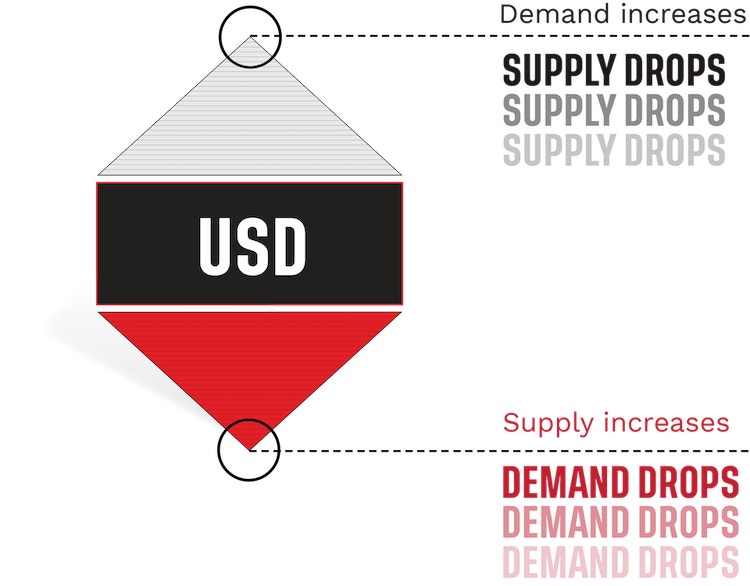
Supply is controlled by central banks, who can announce measures that will have a significant effect on their currency’s price. Quantitative easing, for instance, involves injecting more money into an economy, and can cause its currency’s price to drop.
Central banks also control the base interest rate for an economy.
If you purchase an asset in a currency that has a high interest rate, you may get higher returns. This can make investors flock to a country that has recently raised interest rates, in turn boosting its economy and driving up its currency.
However, higher interest rates can also make borrowing money harder. If money is more expensive to borrow, investing is harder, and currencies may weaken.
Commercial banks and other investors tend to want to put their capital into economies that have a strong outlook. So, if a positive piece of news hits the markets about a certain region, it will encourage investment and increase demand for that region’s currency.
Unless there is a parallel increase in supply for the currency, the disparity between supply and demand will cause its price to increase. Similarly, a piece of negative news can cause investment to decrease and lower a currency’s price. As a result, currencies tend to reflect the reported economic health of the country or region that they represent.
Take a look at our economic calendar to see what’s ahead, and pay particular attention to:
Market sentiment, which is often in reaction to the news, can also play a major role in driving currency prices. If traders believe that a currency is headed in a certain direction, they will trade accordingly and may convince others to follow suit, increasing or decreasing demand
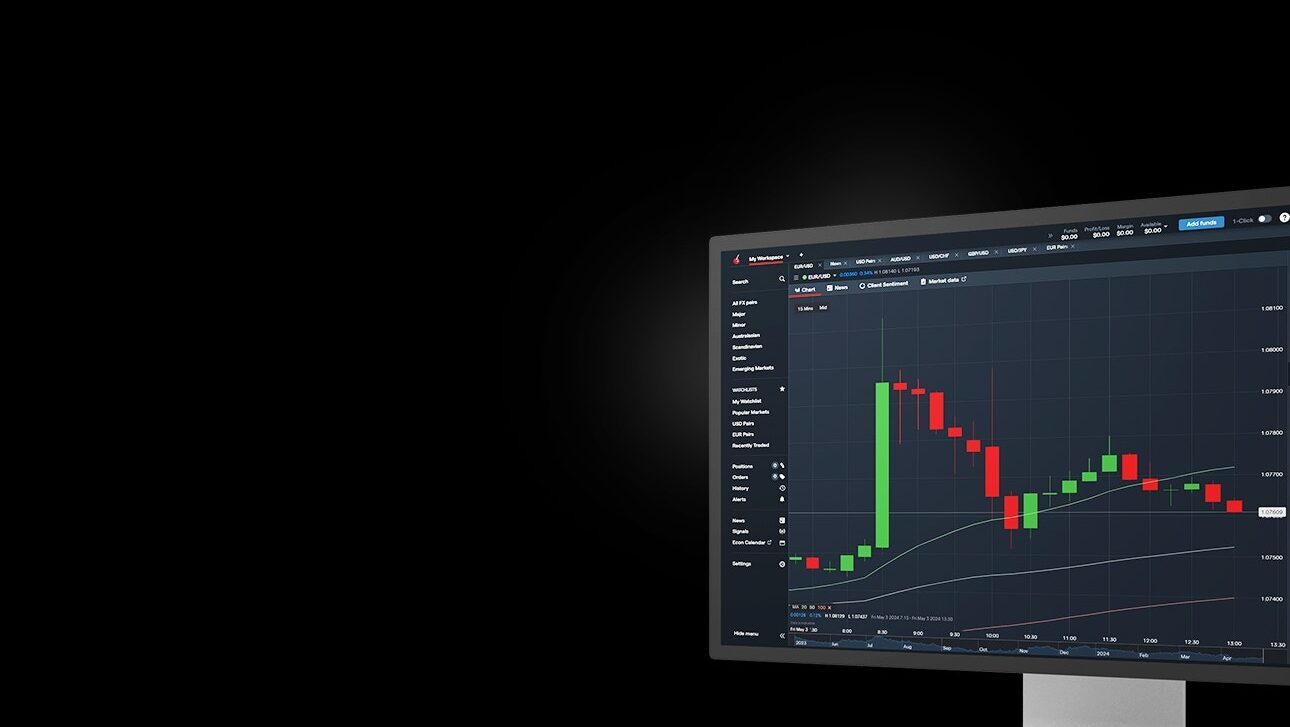
What is forex?
Forex pairs help exchange one currency for another to hedge exposure or speculate on global economies.

Why trade forex?
See if 24-hour access, high liquidity, and low costs make forex products a good fit for your portfolio.
How to trade forex
Market awareness and strategy building are essential to go from theory to practice. Check out examples.
Disclaimer:- Past performance is not necessarily indicative of future results. Leveraged trading in foreign currency or off-exchange products on margin carries significant risk and may not be suitable for all investors. Losses can exceed deposits. We advise you to carefully consider whether trading is appropriate for you based upon your personal circumstances as you may lose more than you invest. The information presented does not take into account your particular investment objectives, financial situation and/or needs and is not a substitute for obtaining professional advice from a qualified person, firm, or corporation, where required. You are advised to perform an independent investigation of any transaction you intend to execute in order to ensure that transaction is suitable for you. Information presented on our website should not be construed nor interpreted as financial advice.
Bestforextrading © All Rights Reserved.